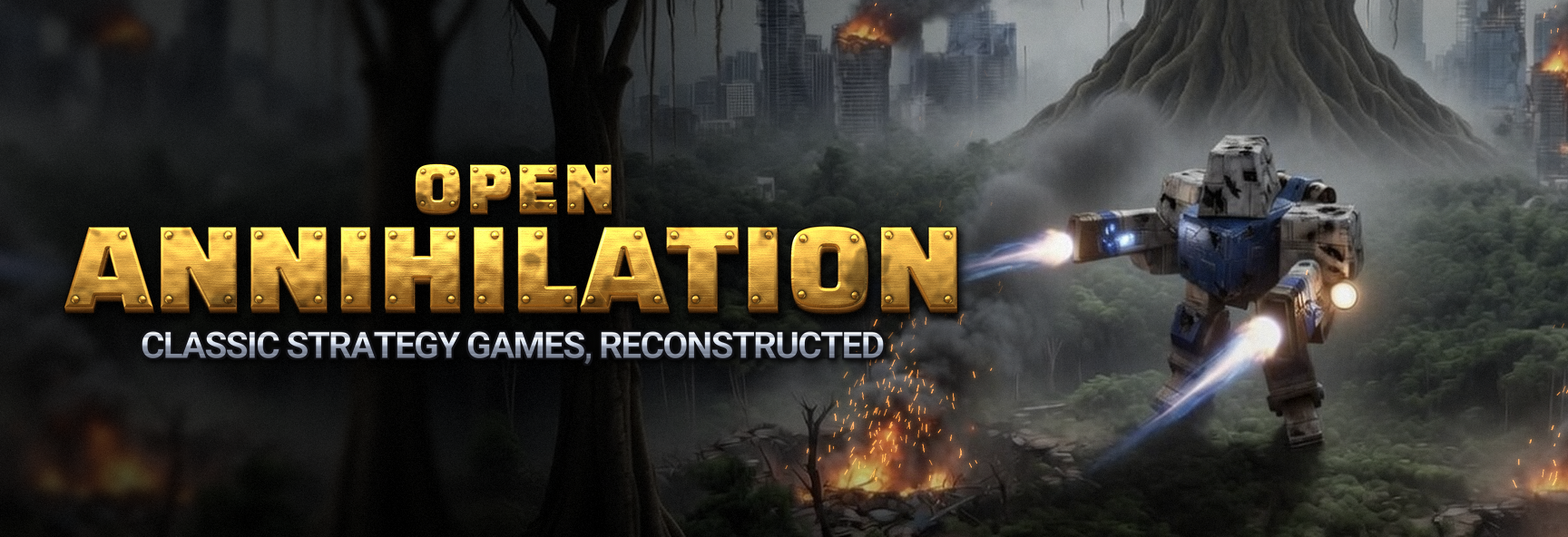
- Open Annihilation 0.8.3 Released: Rise of the Mods, now 22 mods in the Library
Press kit
An open source engine that plays the original Total Annihilation natively on macOS, Windows, Linux, iPhone and iPad, from your own copy of the game. The 0.8 series, Rise of the Mods, adds a Library of over 3,000 community maps, 22 mods including TA Escalation, Rainbow Edition and Great War At Sea, five new playable races and three more languages.
Twenty-two releases in the three weeks since launch on 27 September, itself 29 years to the day after the original game.
The Atlas: over 3,000 community maps, in the LibraryThat ESCalated Quickly: TA EscalationSuper Senpai Lets Go: Rainbow EditionUninvited Guests: five new races
Fact sheet
Project
Open Annihilation
Tagline
Open Source, cross-platform re-implementation of Total Annihilation game engine.
Version 0.8.3, 18 October 2026. First public release, version 0.2, on 27 September 2026, 29 years to the day after Total Annihilation's North American launch
Platforms
macOS 11 or later (Intel and Apple silicon, signed and notarized); Windows 64-bit, 32-bit including XP, Windows 11 on ARM and Windows 95, each with an installer; Linux x86-64 and ARM, including the Raspberry Pi; the Steam Deck, experimentally, with a package of its own; iPhone and iPad, built from source with Xcode
Languages
English, German, French, Spanish and Italian built in; Simplified Chinese (横扫千军), Ukrainian and Korean from the Library, switching without a restart
Library
Over 3,000 community maps, 22 mods including TA Escalation, Rainbow Edition and Great War At Sea, five new races, the Cavedog map packs and bonus units, and language packs, from signed catalogues built into the game
Codebase
More than a million lines of C++20 on SDL3
Price
Free and open source. Requires a copy of Total Annihilation, sold on Steam and GOG, currently $1.49 on GOG. The original free demo, preserved on the Internet Archive, also works.
Licence
GNU General Public License version 3. The engine is free software and will stay that way.
Core Prime, a rebuilt Boneyards service. Its content catalogue is built into the game's Library today; matchmaking and competitive play launch in the coming weeks. Register at coreprime.net
Open Annihilation is a free, open source engine that plays the original 1997 real-time strategy classic Total Annihilation on modern macOS, Windows and Linux machines, on iPhone and iPad, and experimentally on the Steam Deck. It reads the game's own data files and save games from a copy bought on Steam or GOG, or from the original free demo, and aims to match the final official release, version 3.1c, in behaviour rather than reimagine it. Version 0.8, Rise of the Mods, adds a Library that installs over 3,000 community maps, 22 mods including TA Escalation, Rainbow Edition and Great War At Sea, five new playable races and language packs from signed online catalogues, in one place and without a restart.
Long
Total Annihilation, designed by Chris Taylor and released by Cavedog Entertainment on 27 September 1997, is one of the most influential real-time strategy games ever made: three-dimensional units and terrain, physics-simulated projectiles, a streaming economy and a scale of warfare that later games spent years catching up with. The game is still sold today, but it was written for Windows 95 and 1997 hardware, and playing it on a current machine, especially a Mac or a Linux desktop, means compatibility layers, resolution hacks and luck. Open Annihilation's first release arrived on 27 September 2026, 29 years to the day later, and twenty-two releases have followed in the three weeks since.
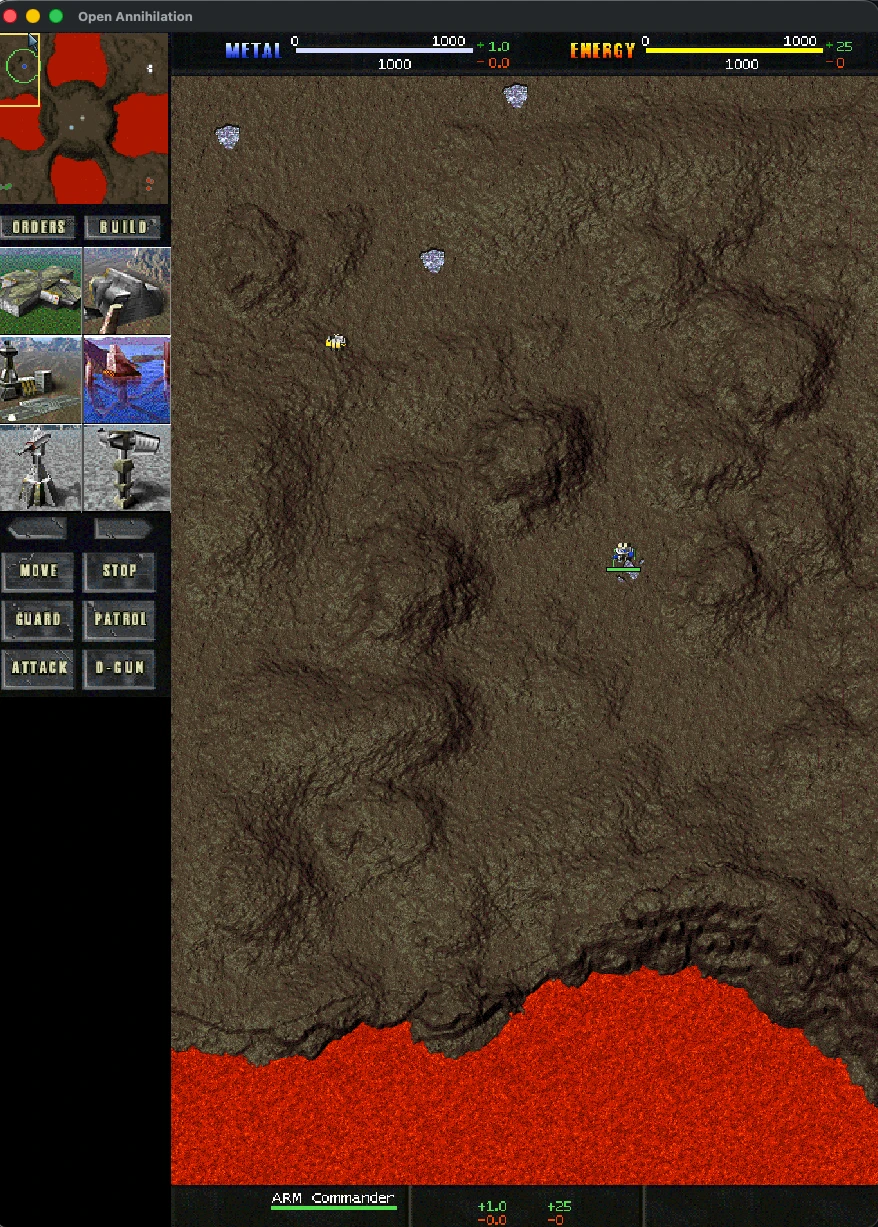
Open Annihilation replaces the original executable with a new, portable engine written from scratch. It ships no game content. Instead it loads the archives, maps, unit models, unit scripts, sounds and music from an installed copy of the retail game, including both expansion packs, The Core Contingency and Battle Tactics. The single-player campaigns, skirmish against the original computer players, network games over the original protocol, mods, recorded games and the original save-game format all run in the new engine, and a built-in Library adds the community's maps, mods, races and languages from signed catalogues. Matches render at any resolution up to 8K with the original 8-bit look intact, drawn by the graphics card where there is one and by the processor where there is not, down to a 256 MB Windows XP machine or a Raspberry Pi.
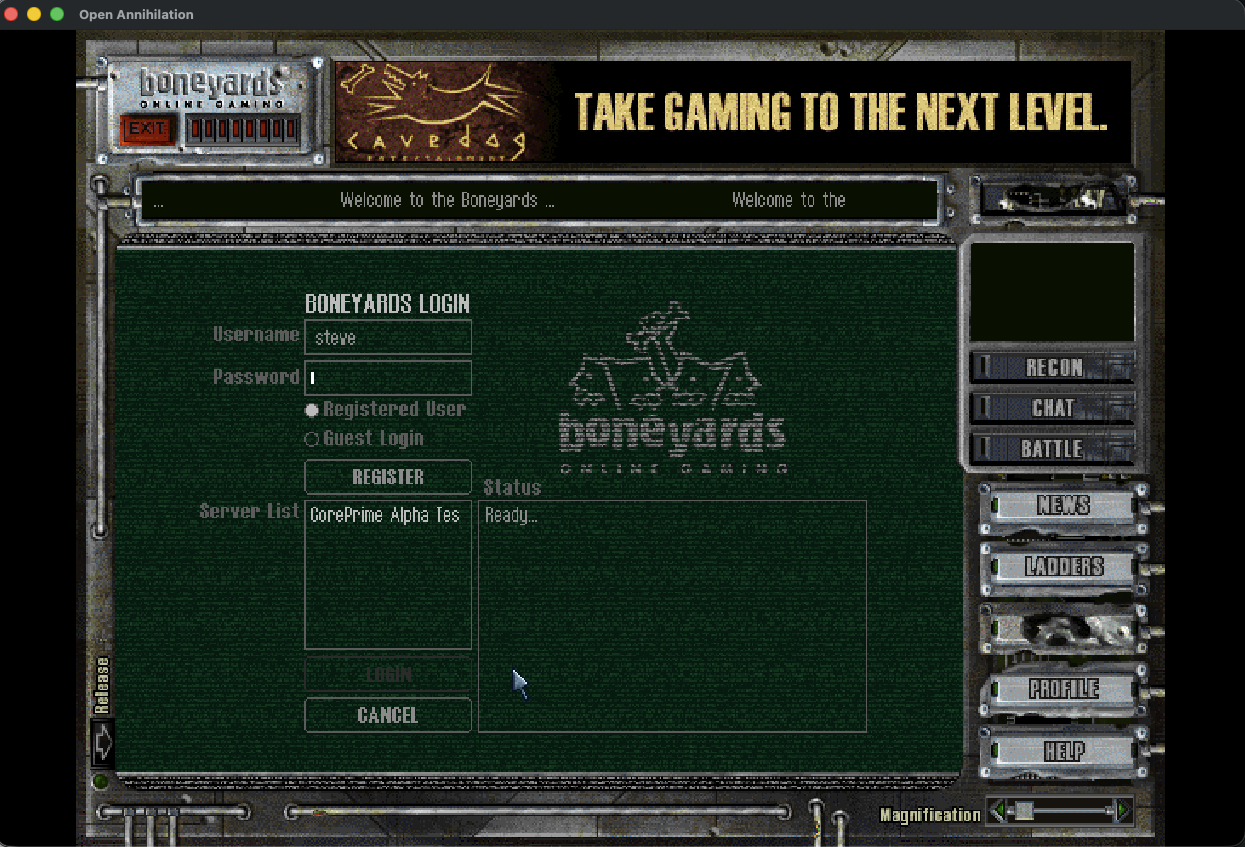
Core Prime, the rebuilt Boneyards service, is already in the game: its catalogue of mods, map packs, bonus units and languages is built into the Library. Its online service for matchmaking and competitive play launches in the coming weeks, and players can register at coreprime.net in advance. The engine already speaks the original game's network protocol, so cross-play with unmodified Total Annihilation clients is possible today.
What it does today
Plays the real game. Loads the retail game's archives, maps, units, scripts, sound, speech, music and movies, including both expansions. No content is bundled or redistributed, and saved games stay compatible with the original.
Single player and multiplayer. The Arm and Core campaigns, skirmish against the original computer players, and network games hosted or joined over TCP/IP using the original game's protocol.
The Library. Mods, map packs, languages and expansions from signed online catalogues, installed, updated, held, rolled back and removed in one place. Core Prime's catalogue is built in: over 3,000 community maps, 22 mods including TA Escalation, Rainbow Edition and Great War At Sea, five new races, the Cavedog map packs and bonus units.
Mods. A mod describes how it differs from 3.1c in one profile file, and the engine applies the standard hacks it names, with no code for any particular mod. Mods that add a third or fourth side put every race on the skirmish Side button.
Recorded games. Plays recordings made by the original demo recorder and records its own network games in the same format.
Eight languages. English, German, French, Spanish and Italian built in, and Simplified Chinese, Ukrainian and Korean from the Library, with every word of the engine's own interface translated and Unicode chat between players.
Modern hardware, original look. Full hardware acceleration, smooth motion at up to 120 frames a second between the game's 30 ticks, anti-aliasing, modern fonts, and zoom from the whole map down to the ground, with the 8-bit palette rendering intact.
Old hardware too. Deterministic across x86 and ARM, 32-bit and 64-bit, and built to run on a 256 MB, single-core Windows XP machine or a Raspberry Pi.
Native on every platform. Separate builds for macOS, Windows and Linux, a touch interface for iPhone and iPad, and experimental support for the Steam Deck with its own controls.
Free software. Released under the GNU GPL version 3, with a test suite that checks the engine against the data of an installed copy of the game.
What's new since launch
Version 0.2 shipped on 27 September as a playable single-player engine for macOS, Windows and Linux. Twenty-two releases later, the 0.8 series, Rise of the Mods, turns the engine into a platform for everything the community has made for the game. The major additions, in the order they landed:
Signed and notarized macOS app with an installer, and smooth motion at up to 120 frames a second, interpolating units, projectiles, effects and the camera between the game's 30 ticks. (0.5)
Old and small computers. A 32-bit Windows build that runs on Windows XP with 256 MB of memory and a Pentium III, Linux builds back to glibc 2.28 and for the Raspberry Pi, and battles up to 45% faster on one core, drawn across spare cores on bigger machines. The engine plays its own movies and music, so FFmpeg is gone and packages shrank by a fifth. (0.6)
The same game on every machine. Angles and lengths are computed with integer arithmetic, so x86 and ARM, 32-bit and 64-bit, play every game identically, and results no longer depend on what is drawn. Aircraft fight and missiles fly as in 3.1c. (0.6)
Multiplayer. Host or join a game over TCP/IP from the Multiplayer menu and set it up in the battle room. The engine speaks the original game's protocol, so cross-play with native Total Annihilation clients is possible. (0.6.1)
Full hardware acceleration. The graphics card draws the whole battlefield, with vertical sync and anti-aliasing up to 16x, and the processor still draws every frame where there is no card. (0.7)
Mods. The OAMOD profile standard: a mod states how it differs from 3.1c in one file, choosing from 90 standard hacks in 16 areas, from computer players and aircraft to the interface and weapons, plus unit-script extensions. A Mods page switches between them without restarting, a Developer Mode tries any hack on any mod, and a mod packs into one .oamod file that installs with a double-click or a drop onto the window. (0.7, 0.7.1)
iPhone and iPad. Touch controls made for the game: tap to move, a build drawer, an order wheel on a long press and pinch to zoom. The app copies the game data from your own copy on first start. It is built from source with Xcode; there is no App Store release. (0.7)
Languages. English, French, Italian, German and Spanish from the translations in the game data, modern fonts with outline and shadow at 50% to 300%, and then the whole game in Simplified Chinese, 横扫千军, with a bundled font, system input methods for chat and save names, and Unicode chat that keeps non-Latin text intact between players. Languages come as packs, so more can be added. (0.7, 0.7.2)
Your files in Documents. Saved games, screenshots, recordings and mods live in an Open Annihilation folder in Documents, a settings dialog reachable from the OA button covers everything with a documented page per setting, and downloaded saves, archives and recordings can no longer write outside their folders. (0.7, 0.7.1)
Steam Deck, experimentally: the Linux build added to Steam as a non-Steam game, with the right trackpad as the pointer, grips, rings for orders and building, prompts and haptics. (0.7.1)
Demo recorder. Recordings made by the original game's demo recorder play back from the command line, and the engine records its own network games in the same .tad format. (0.7.1)
The view. Zoom out until the whole map fits, smooth zoom that stays on the point under the pointer, every resolution the display offers including 4K and ultrawide, and explosions that flash as in 3.1c, with a Full, Reduced or Off setting for players sensitive to flashing light. (0.7.2)
A steadier view and more room. The ground no longer shimmers while the camera follows a unit at any zoom, the view can reach past the map's edge by a chosen amount, the side panel and bars can keep the original game's size, and the window's frame hides while you play. Computer players build from each builder's whole list as in 3.1c, and a game can be hosted or joined straight from the command line. (0.7.3)
Closer to 3.1c, and on Windows 95. Mission briefings with a turning planet, a scrolling panorama and the wind and gravity, build mode that ends when Shift is let go, Full graphics that hold up in the biggest mod battles, a Steam Deck package of its own, and a game executable cut from 16.9 MB to 10.9 MB on macOS. The engine also builds from source for Windows 95, the system the original game was written for, a contribution from Zane van Iperen. (0.7.4)
The Library. One place for everything you add to the game. Mods, map packs, languages and expansions come from signed online catalogues and are installed, updated, held, rolled back and removed from tabs for Active, Mods, Maps, Languages, Updates and Registries, with previews, filters, tags and search. Other registries can be added by address or by opening an .oareg file. (0.8)
Over 3,000 community maps. The skirmish and battle room list every map, installed or not, in one list; a map not yet installed reads Available, and GET MAP fetches it from the battle room. Map packs come as .oamap files, and the 16 Cavedog map packs are in the catalogue. (0.8)
The mods. Core Prime's catalogue is built in and already offers 14 mods: TA Escalation, Rainbow Edition, Talon, The Lost Legacy, Rhyoss, Mynn, The Final Frontier, World Domination, TA:UIP, TA:UCP, UTASP, TABA and UberHack among them, plus Cavedog's bonus units. (0.8)
Five new races. Argon, Mynn, Rhyoss, Talon and The Lost Legacy join Arm and Core. Mods with a third or fourth side show every side on the skirmish Side button, and a side chosen under one mod opens on a race under another. (0.8)
Three more languages, and the whole interface translated. German, French, Spanish and Italian are built in; Simplified Chinese, Ukrainian and Korean download from the Library and switch without a restart. Every word of the engine's own interface is translated, and text that does not fit a 3.1c button shrinks rather than being cut. (0.8)
Windows 95 as a first-class build, with installers for all four Windows packages that set up the Start Menu, Add/Remove Programs and the file types. A first-run setup chooses your language and reads the GOG installers for Windows and macOS directly, copying the game once into Documents. Launch files (.oalaunch) let a launcher, a server or a shortcut start a fully set-up battle room. (0.8)
Computer players that play a mod as its author meant. They follow a mod's whole AI profile and build lists as 3.1c does, so in TA Escalation they go on to tiers 3 and 4 instead of building factories without end, and a computer player's silo stockpiles its nukes. Saved games load in a fraction of the time, a first-run copy that stopped part way carries on, a Smooth motion setting can draw units 30 times a second as the original did, and the zoomed-out view draws faster. Argon, Total Mayhem and TA: Zero join the Library. (0.8.2)
Race and multiplayer mods. A unit script with a deep expression runs as in 3.1c, so Devolution's Command Beacon teleports the Commander, a third side draws its own panel art, as Rumad does, and a frame draws about a millisecond faster zoomed far out. The Library grows to 22 mods with The Pack, XTA, Armored Typhoon, xubor mod and Great War At Sea, and its maps are tagged by the world their tiles come from and, for naval mods, by a sea start. (0.8.3)
Release timeline, newest first
0.8.3
Deep unit-script expressions as in 3.1c (Devolution's beacon), a third side's own panel art (Rumad), faster frames zoomed out; 22 mods in the Library
0.8.2
Computer players follow a mod's whole AI profile, silos stockpile nukes, saved games load in a fraction of the time, first-run setup carries on, Smooth motion setting; Argon, Total Mayhem and TA: Zero
0.8.1
Hotfix for Windows: the game finds its own language, registry and log files again
0.8.0
Rise of the Mods: the Library, over 3,000 maps, 14 mods, five new races, Ukrainian and Korean, Windows 95 with installers, first-run setup, launch files
0.7.4
Animated mission briefings, Full graphics in the biggest battles, a Steam Deck package, smaller programs, Windows 95 from source
0.7.3
A steady camera when following units, view past the map's edge, HUD scaling, computer players that build as in 3.1c
0.7.2
Simplified Chinese, Unicode chat, explosion flash, zoom to the whole map, every screen size
0.7.1
Steam Deck, .oamod installs, demo recorder playback and recording, every setting documented
0.7.0
Full hardware acceleration, mods, iPhone and iPad, five languages, modern text, files in Documents
0.6.1 to 0.6.2
Multiplayer over TCP/IP with the original protocol; data-file parsing matched to the original, historical bugs included
0.6
Windows XP, 32-bit and Raspberry Pi; up to 45% faster; deterministic across processors; aircraft as in 3.1c; no FFmpeg
0.5 to 0.5.3
Signed macOS app and installer, smooth motion up to 120 fps, the settings dialog
0.3 to 0.4.3
First binary releases and launch-week fixes
0.2
Launch: single player on macOS, Windows and Linux, 29 years to the day after the original
Full notes for every version are on the releases page.
Current state
Open Annihilation is playable today in single player, the Arm and Core campaigns and skirmish against the computer players, and over the network with other Open Annihilation players or, over the original protocol, with unmodified copies of the game. The Library installs over 3,000 community maps, 22 mods including TA Escalation, Rainbow Edition and Great War At Sea, five new races and eight languages. Core Prime's catalogue is built in; its online service for matchmaking and competitive play launches in the coming weeks. iPhone, iPad and Steam Deck support is new and looking for testers.
Roadmap
Core Prime, a Boneyards-compatible multiplayer service for matchmaking and competitive play, launching in the coming weeks.
More of the community's mods in the Library, Devolution, Rumad and Twilight among them.
The rest of the single-player game, closing the remaining gaps against 3.1c.
TA: Kingdoms and Iron Plague support.
Modding tools
Alongside the engine, Steve Gray has released Kbot, a full suite of modern, cross-platform modding tools for Total Annihilation and Total Annihilation: Kingdoms. Kbot is open source under the MIT licence and runs on macOS, Windows and Linux.
One command-line tool that reads and writes the game's file formats: HPI archives, GAF and TAF animations, PCX images, palettes, bitmap fonts, TNT maps and map sections, 3DO models, COB unit scripts and TA: Kingdoms scenarios.
Kbot Studio, a browser-based workbench for browsing, previewing and inspecting every asset in an installed copy of the game.
A written reference for each of the game's file formats, and a Model Context Protocol server so AI assistants can work with game assets directly.
Steve Gray has been part of the Total Annihilation community for more than 25 years. He ran Planet Annihilation, one of the game's main fan sites during its heyday, and has followed the game through its patches, expansions and community mods ever since.
The idea of rebuilding the engine so the game could outlive Windows 95 first came up on a community forum more than twelve years ago. Like many such projects it stalled: reverse engineering a 1997 engine, its dozen file formats and its unit scripting language is a multi-year job for a single developer working evenings.
What changed is AI. Working with AI coding assistants, the author was able to turn years of accumulated community knowledge about the game's formats and behaviour, together with his own independent research into the game's network protocols and file formats, a personal project since 2014, into a working engine in a fraction of the time, while a growing test suite checks every part of it against the data and save files of an installed copy of the game.
How it was built
The engine was reverse engineered from the 1997 releases of the game and from the Boneyards-era updates of 1999 and 2000, released in the final days of Cavedog Entertainment. The file format handling that makes up much of the code was informed by community documentation dating back to 1997 and 1998, when modders first pried the game apart to build their own units and maps. That documentation was refreshed and updated as part of the Kbot project. The original executables were analysed with Ghidra, the open source software reverse engineering suite. The output of that analysis was not code but a set of specifications and tests describing how the game behaves, and the body of game logic was then implemented from those specifications, with Anthropic's Claude models, Fable and Opus, doing the bulk of the implementation under the author's direction alongside other tools, and the tests checking the result. The engine has grown to more than a million lines of code, and its test suite also checks it against the data and save files of an installed copy of the game.
Quotes
"I first remember opening PC Gamer magazine in 1997 and seeing a giant pull-out ad for Total Annihilation, an A3 sized single screenshot. 3D units, meaningful terrain and physics, and battles on a scale that other games didn't do. Ever since I've played Total Annihilation, tinkering with the game and its sequel, and being part of the game's community.
"The lack of source code for the game has challenged players and creators for decades, as limits with the technology kept getting in the way of ideas. After trying to get the multiplayer services working again over a decade ago, it was too time consuming so I parked the project. Fast forward to today, and with AI I was able to realise the project - and hopefully let Total Annihilation be enjoyed by a new generation of players."
Steve Gray, author of Open Annihilation
About Total Annihilation
Total Annihilation was released in North America on 27 September 1997 by Cavedog Entertainment, a division of Humongous Entertainment, and published by GT Interactive. Designed by Chris Taylor, it was followed by two expansions, The Core Contingency (1998) and Battle Tactics (1998), and by a stream of free downloadable units and maps from Cavedog, an unusual practice at the time. Its final official patch is version 3.1c, which Open Annihilation targets.
The game remains on sale with both expansions included. At the time of writing GOG lists the Commander Pack at $1.49. The original free demo is preserved on the Internet Archive and also runs in Open Annihilation, so anyone can try the engine without buying the game.
All images on this page may be used freely in coverage of the project. Screenshots show the original game's art, which belongs to its rights holders.
Screenshots
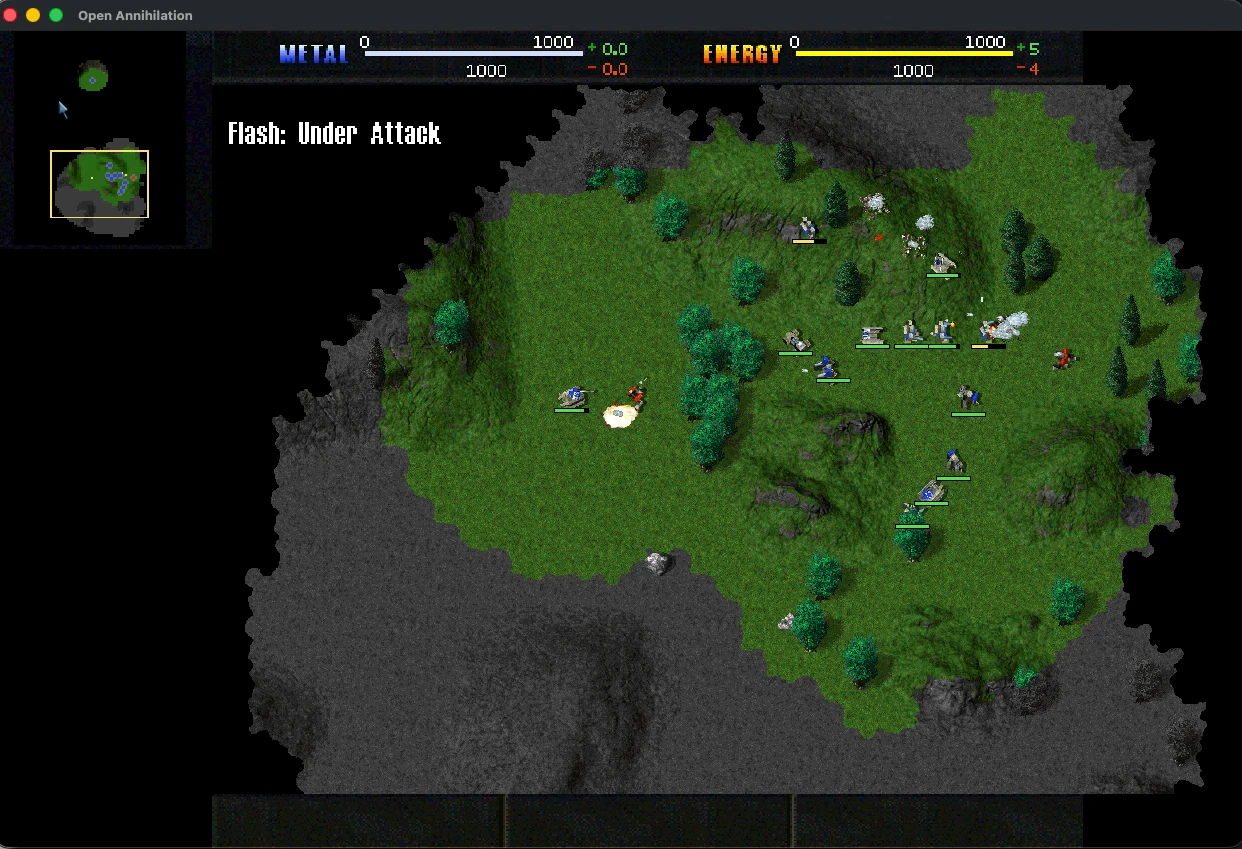
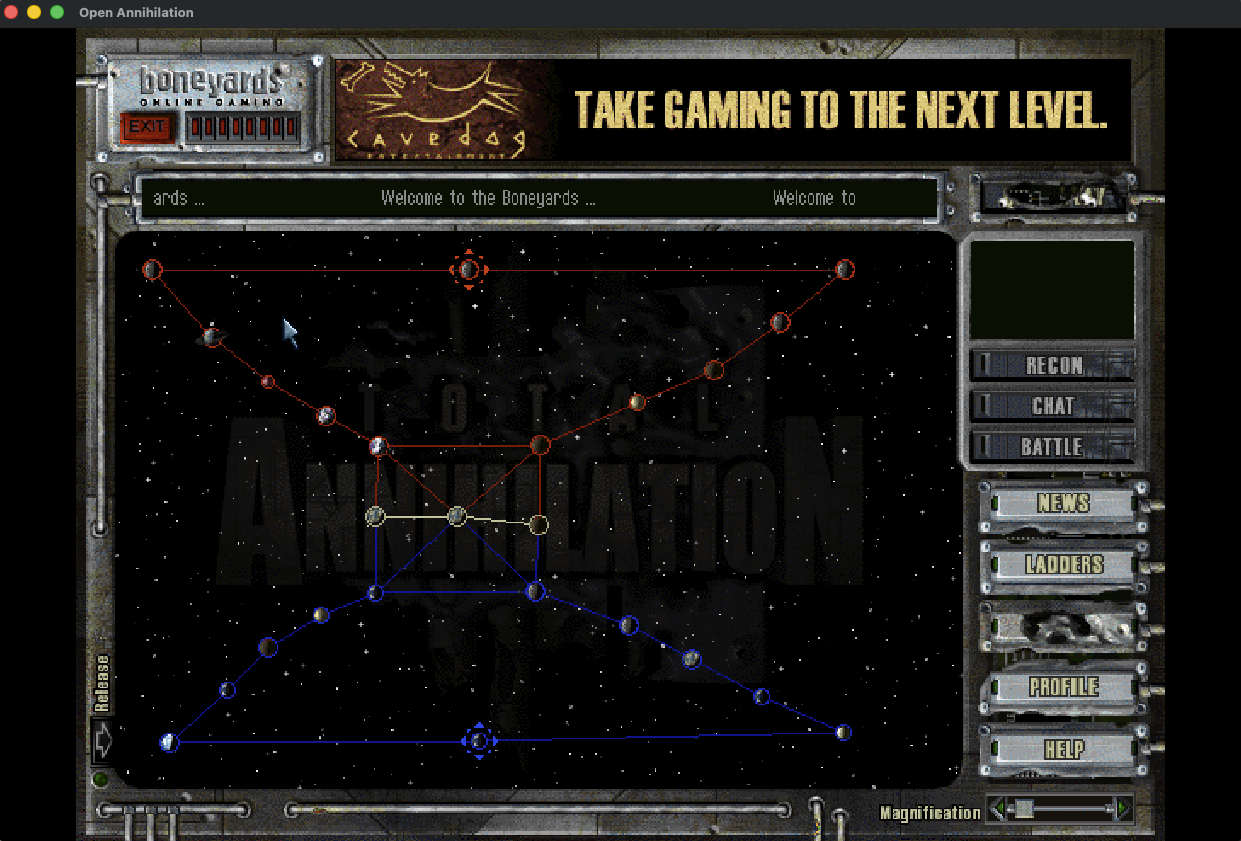
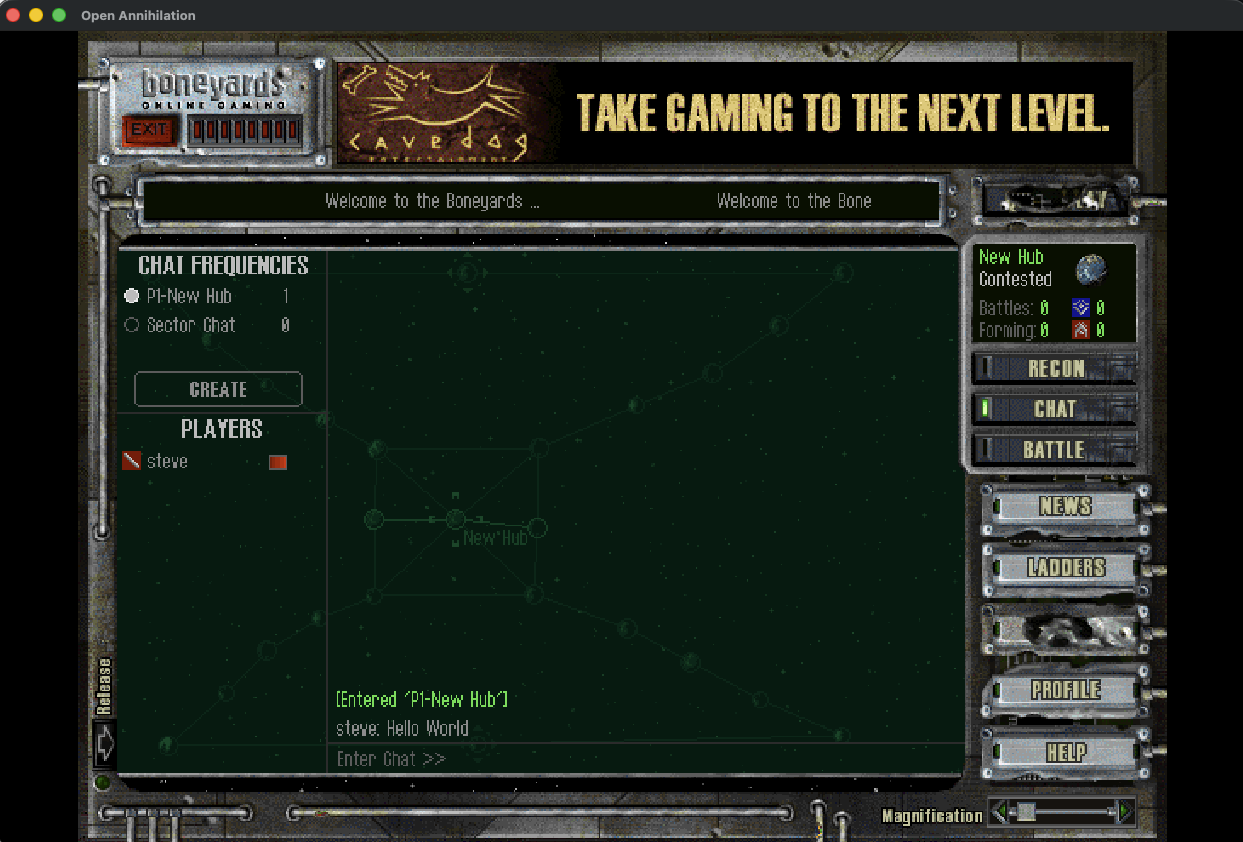
Every capture below is the engine running natively on macOS, window title bar included. Click any image for the full-size PNG.
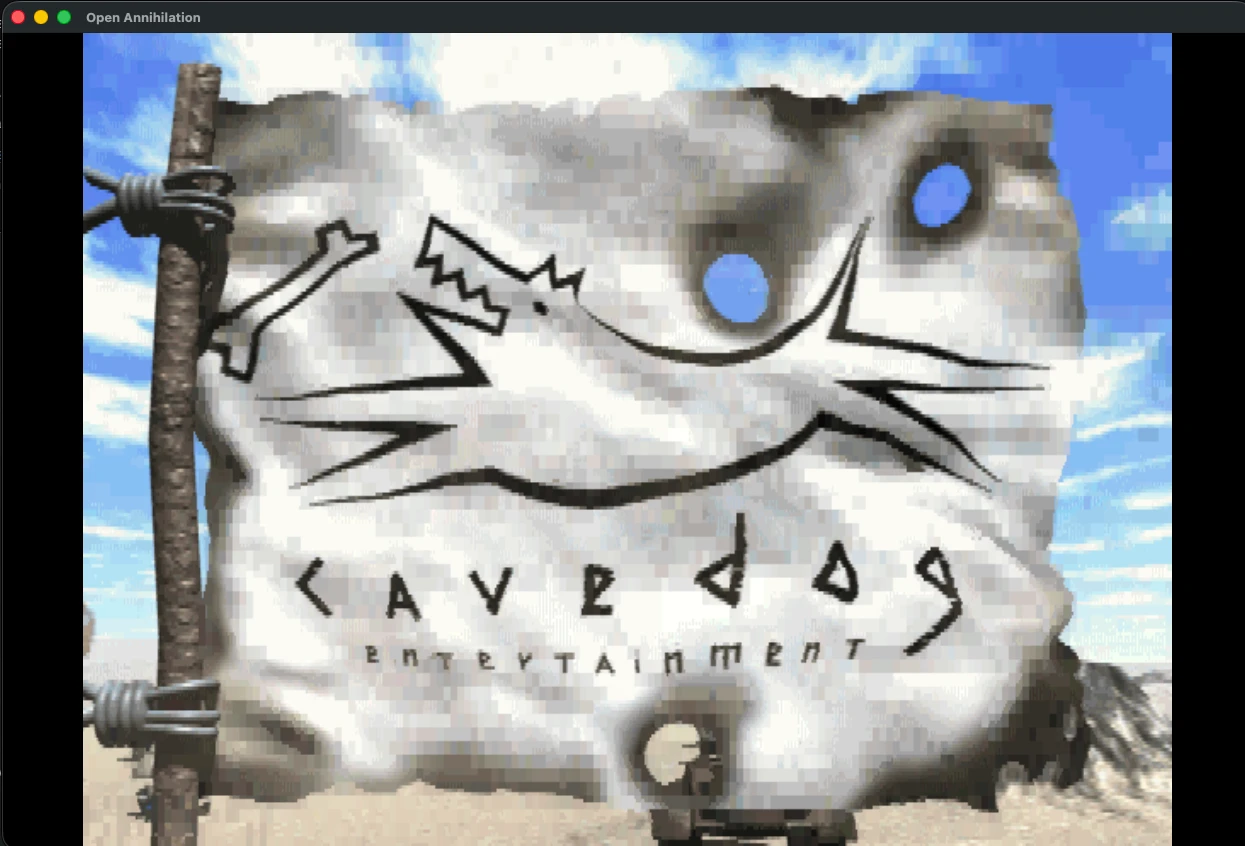
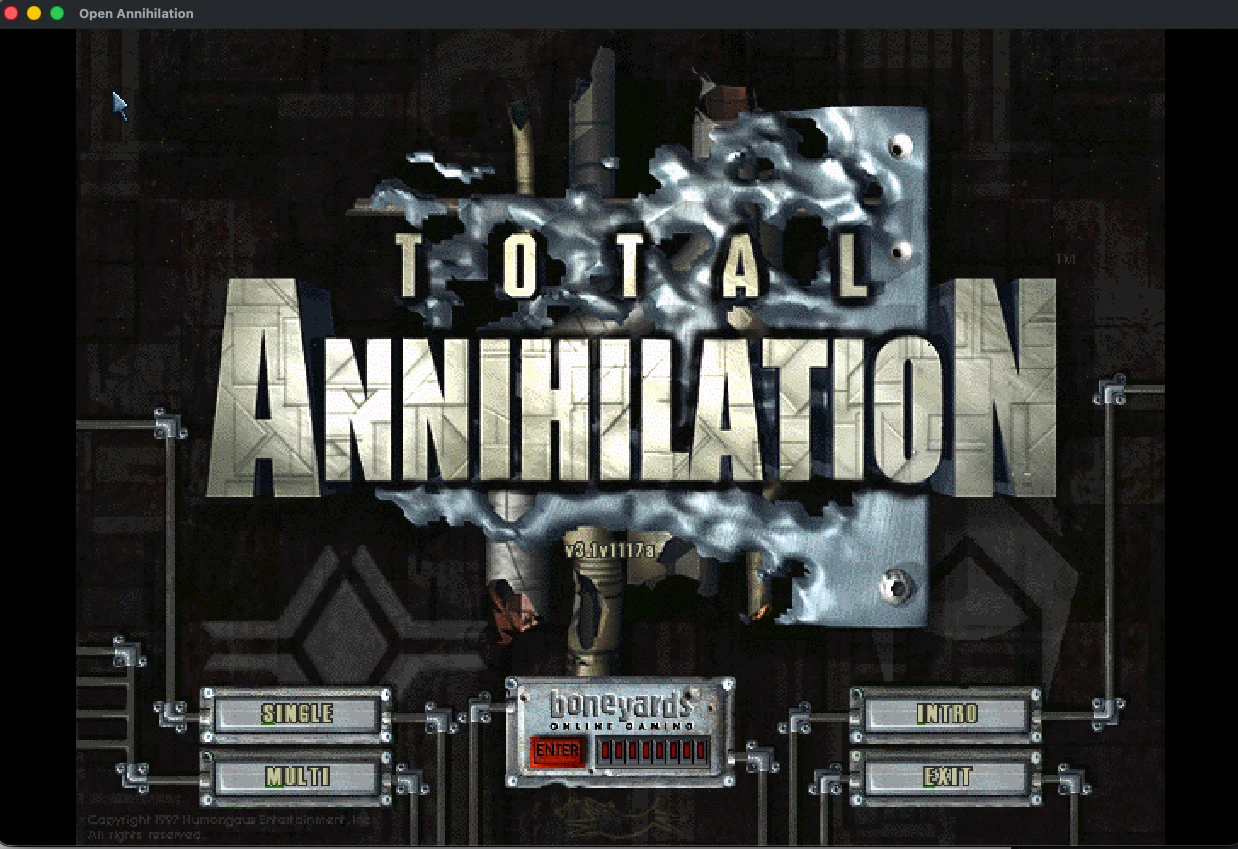
Intro playback: the original Cavedog Entertainment intro, played by the engineMain menu, the original frontend running in Open AnnihilationCampaign playBoneyards login screen, connecting to the Core Prime serviceBoneyards Galactic War mapBoneyards chatVariable resolution support: the game in a portrait window
Open Annihilation is a new engine that contains none of the original game's code, art, sound or data. It requires a legitimately purchased copy of Total Annihilation and reads the game's files from that copy at run time. It is not affiliated with, endorsed by or supported by the owners of the Total Annihilation trademark.
This is a well-established way of keeping classic games alive. OpenRA has run the original Command & Conquer and Red Alert assets in a new open source engine for well over a decade, and in February 2025 Electronic Arts went further and released the original games' own source code under the GPL. OpenMW does the same for Morrowind, OpenXcom for X-COM, OpenRCT2 for RollerCoaster Tycoon 2, CorsixTH for Theme Hospital, and ScummVM for hundreds of classic adventure games. In every case the player buys the original game, and the open engine gives it a future on hardware and operating systems its makers never saw.
Does it include the game?
No. Buy Total Annihilation on Steam or GOG, install it, and point Open Annihilation at the installation folder on first launch. To try the engine without buying the game, the original free demo from the Internet Archive works the same way.
How is this different from Spring or Beyond All Reason?
Spring and Beyond All Reason are new games inspired by Total Annihilation, with their own units, balance and rules. Open Annihilation runs the actual game: the original units, maps, campaigns, scripts and balance, from the original data files, with the aim of matching version 3.1c's behaviour closely enough that its save games load.
Why not just play the original?
On a current Windows machine the original can be made to work with community patches. On macOS and Linux it means Wine or a virtual machine, and on any platform high resolutions, modern displays and future operating system changes are a constant fight. A native, open engine removes that fight permanently, and gives the community a codebase it can fix and extend.
Does it work with mods and community units?
Yes. Community maps and units that use the game's own data formats work as they do in the original, and the engine plays full mods by their own rules: a mod describes how it differs from 3.1c in one profile file and the engine applies the standard hacks it names, with no code for any particular mod. Since 0.8 the Library installs them from signed catalogues, and Core Prime's catalogue already offers 22 mods, TA Escalation, Rainbow Edition and Great War At Sea among them, five new races, over 3,000 community maps and the Cavedog map packs and bonus units. Mods also install from a single .oamod file, and other catalogues can be added by address. For building and inspecting content, the author's Kbot toolchain covers the same formats the engine reads.
What does it run on?
macOS 11 or later on Intel and Apple silicon, Windows 95, Windows from XP SP3 on 32-bit through current 64-bit Windows, and Windows 11 on ARM, each with an installer; Linux on x86-64 and ARM, including the Raspberry Pi; iPhone and iPad, built from source with Xcode since there is no App Store release; and, experimentally, the Steam Deck. The smallest supported machine has one Pentium III-class core and 256 MB of memory.
Can I play online?
Yes. Host or join a game over TCP/IP from the Multiplayer menu and set it up in the battle room; a map a player lacks is fetched from the battle room with GET MAP. The engine speaks the original game's protocol, so it can play with unmodified copies of Total Annihilation as well as with other Open Annihilation players. Core Prime's catalogue is built into the Library today; its service for matchmaking, ladders and competitive play launches in the coming weeks, and you can register in advance at coreprime.net.
Can I contribute?
Yes. The source is on GitHub, the build takes a few minutes on any of the three platforms, and the README describes the layout and conventions. Bug reports from players who know the original game well are especially valuable.
Is all of it open source?
Yes. The engine is released under the GNU GPL version 3 and will remain free.
Boilerplate
For copy and paste into coverage:
Open Annihilation is a free, open source engine that plays the original 1997 strategy classic Total Annihilation natively on macOS, Windows, Linux, iPhone and iPad, and experimentally on the Steam Deck. It contains no game content and instead loads the maps, units, campaigns and save games from a copy of the game bought on Steam or GOG, including both expansion packs, aiming to match the final official release exactly. Its first release, on 27 September 2026, came 29 years to the day after the original game's North American launch. Twenty-two releases later, version 0.8, Rise of the Mods, adds a Library that installs over 3,000 community maps, 22 mods including TA Escalation, Rainbow Edition and Great War At Sea, five new playable races and eight languages from signed online catalogues, on top of network play over the original game's protocol and full hardware acceleration, while still running on Windows 95 or a Raspberry Pi. It is developed by Steve Gray, a member of the Total Annihilation community for more than 25 years and the former owner of the fan site Planet Annihilation. Core Prime, a rebuilt Boneyards online service, launches in the coming weeks. The engine is free software under the GNU GPL version 3. Website: play.coreprime.net. Source code and downloads: github.com/open-annihilation/open-annihilation